
Visiting Syracuse’s Archaeological Park 2025
Planning a visit to Syracuse’s stunning Archaeological Park?
Visiting Syracuse’s archaeological park is an absolute must-do when in Sicily and was a real highlight of our trip.
Situated just a walk from the old, historical centre of Ortygia, the archaeological park is small enough to explore properly and in great condition.
Syracuse itself is full of history, and the Syracuse Archaeological Park is brimming with charm, character, and an insight into the past. The Neapolis Archaeological Park of Siracusa contains both Greek and Roman architecture lying side by side. You’ll find:
- The Greek Theatre
- The Quarry
- The Roman Amphitheater
Although we are no history buffs we found the site fascinating and beautiful in equal measure. It is a shame there isn’t more information freely available throughout the park.
If you like to know what you’re looking at then I recommend doing a bit of reading beforehand or paying for the information available at the ticket office.
As we’re on a budget we used trusty google to guide us around!

As an Amazon Associate, we earn from qualifying purchases. We also earn from other affiliate programs. This means we may receive a small commission on products purchased through our links at no extra cost to you.
Table Of Contents
Jump to what you’re looking for!
When To Visit
Honestly, there isn’t really a best time to visit Sicily, but you might have a preference depending on how you cope with warmer weather.
Spring
We visited Syracuse’s archaeological park in April when there were very few crowds and at times it felt as though we had the site all to ourselves.
Spring was probably our favourite time in Sicily as the weather is improving (you’ll still get some cloudy days and storms), and the spring flowers are starting to bloom, but it’s not stiflingly hot yet and the crazy crowds haven’t arrived!
Summer
In the height of tourist season it is much busier, but don’t let that put you off. There are plenty of places to hide from the crowds and get lost in a little history.
The problem with the summer months is more likely to be the heat. Sicily gets extremely hot during the months of July and August, so be well prepared with plenty of sun cream and cover-ups, and don’t push yourself to fit in too much!
Winter
During the winter months many of the main tourist attractions close, so make sure you check carefully before heading here! The weather is mixed in the winter in Sicily.
As Sicily is part of Italy it’s easy to assume the weather is the same, but Sicily does seem to have a warmer climate over winter. Some days are beautiful and warm (we were in t-shirts but the locals were still in coats!) Some days can be stormy and miserable. It’s just potluck!
How To Get To Syracusa
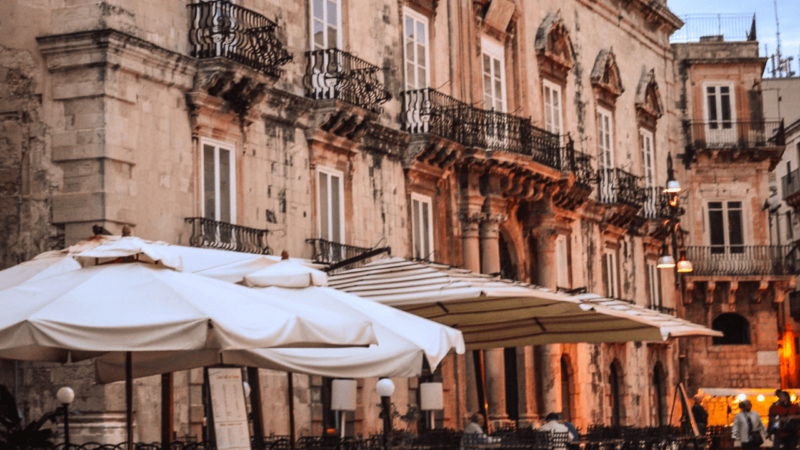
You’ll want to stay in Ortigia itself rather than close to the archaeological park (suggestions below). It’s a far prettier part of the city, and the journey to get from Ortigia to Syracuse’s archaeological park isn’t too hard.
Getting to Syracusa is quite easy too, so it’s a good place to base yourself for a holiday in Sicily.
Most people arrive at Catania airport. From here there is a regular coach that only takes one hour. You’ll find the ticket booth just outside the airport. You could also opt for a taxi but it will be quite a lot more expensive!
If you prefer, you can fit in a visit to Syracusa and the archaeological park in a days tour. This is a great option for anyone who is a little short of time on their visit to Sicily, and it’s also one of the easiest ways to visit as the whole trip will be planned for you and you’ll simply be taken to all the best spots!
The other option you have is to hire a car. This is perfect for anyone who loves a little freedom when they travel.
The roads in Sicily are mostly good though you’ll want to be a little picky with sat nav, which might try and take you the ‘fastest’ route down the odd dirt road!
If hiring a car is for you then why not take a southern Italy road trip and properly explore this incredible area?
What To Expect When Visiting Syracuse’s Archaeological Park

The Greek Theatre
The Greek Theatre is on the right-hand side of the path as you pass the ticket office, and is arguably the most impressive part of Syracuse’s Archaeological Park.
This beautiful ancient theatre has been preserved to a high standard and as you approach you will be greeted with gleaming white stone steps leading down the stage below.
Dating back to at least the 5th century BC, the Greek theatre is among the largest ever built.
Its 59 rows could accommodate up to 15,000 spectators and has staged the works of Sophocles, Euripides, and the last tragedies of Aeschylus, including The Persians, Prometheus Bound and Prometheus Unbound, which were first performed here in his presence.
The theatre is still used for performances and there is a festival that runs from late spring. If you are lucky enough to be visiting at this time then it would be well worth trying to book a ticket.
Be aware: As this is a working theatre there are often building works going on here. Although not the prettiest, it didn’t ruin the experience for us. If you are lucky enough to get tickets to one of the performances here we imagine you would be in for a treat!
The Quarry
From a path leading down beside the Greek theatre you will find the strange Latomia del Paradiso, a deep limestone quarry that provided stone for the ancient city and later became a prison for 7000 survivors of the war between Syracuse and Athens in 413BC.
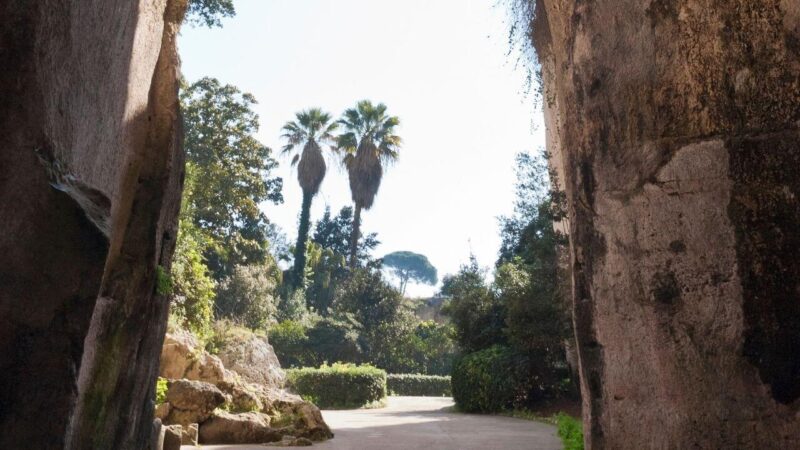
It is riddled with catacombs (most of which you are unable to enter) and filled with citrus and magnolia trees.
It is here that you will find relief from the heat of the sun. This area, although small, makes a pretty place to rest your feet for a while before exploring the Roman amphitheater.

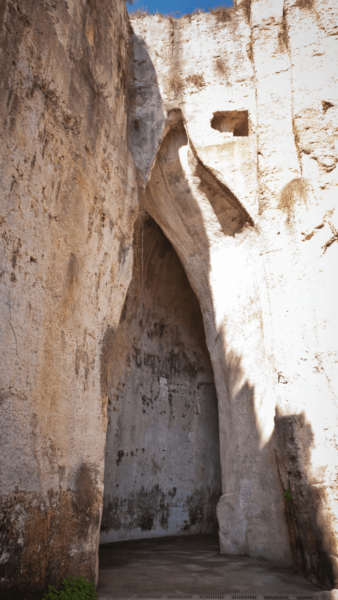
The Orecchio di Dionisio is an unusual site and one that is not to be missed. This 23m-high cave extends 65m back into the cliff and was named by Caravaggio after the tyrant Dionysius, who is said to have used the acoustics of the quarry to listen in on his prisoner’s whispered secrets.
We can see how this would be possible, as even a whisper at the back of this grotto is amplified to enormous levels due to the ear-like shape of the cave!
Kids and adults alike will have endless amounts of fun whispering messages to each other and singing at the top of their voices.

The Roman Amphitheater
On the right-hand side you will find the entrance to the 2nd-century Roman amphitheater. S
adly much of it was destroyed by The Spaniards in the 16th century when they used the stones to build Ortygia’s city walls. It is large, measuring 140 meters by 119 meters, and had a much more gory purpose than the civilised Greek plays.
The Romans used the amphitheater for gladiator fights with wild animals and horse races. In the centre of the arena is a rectangular room that is supplied by two canals. This area was possibly used to collect the blood and gore from the gruesome contests that took place.

West of the amphitheater is the 3rd-century-BC Ara di Gerone II. This is a monolithic sacrificial altar, where up to 450 oxen could be killed at one time.
For a more detailed historical account of the site visit the park’s own website (and make sure google translate is switched on if you don’t speak Italian!)
We used this information to guide us around the site and found it just as good as any tour guide or audio guide!
How To Get To Syracuse’s Archeological Park
Walk
The thirty-minute walk from Ortygia isn’t the most beautiful, but you will pass a few of Syracuse’s sights on the way, so it may be worth combining. It’s also the most ecological of all the options, and the best for you, so there’s that!
Drive
The quickest way to get to Syracuse’s Archaeological Park from Ortygia is by car, just a five-minute drive and there is plenty of parking along the road beside the archaeological park at just a few euros.
Pay at the machine near the entrance.

Bus
There is a bus from Molo Sant Antonio, on the west side of the main bridge into Ortygia that will take around 15 minutes and cost 1 euro per person.
What you need to know when visiting Syracuse’s archaeological park
We’ve included all the basic information you could need for a visit, but it’s well worth checking out the official website before your visit and information does change depending on the time of year and whether or not there are any special events taking place.
As always, it’s worth taking precautions against pickpockets while you’re in busy tourist areas. We always felt very safe in Sicily but you do hear of reports of theft from time to time.
Ticket Price For Visiting Syracuse’s Archaeological Park
10 euros per adult, with discounts for children, students, and Italian teachers.
Tip: Keep hold of your ticket for the entire trip. You will end up needing it on more than one occasion!
We thought this was a little steep, considering that you will pay the same for a ticket to Sicily’s more famous (and much, much bigger!) Valley of the Temples.
If we had to pick only one we would have visited Valley of the Temples, but if budget allows then we think Syracuse’s archaeological park is definitely worth a visit too.
Opening times
8.30am-1hr before sunset. Go early or late to avoid the worst of the crowds.
Facilities
There is a small (expensive) cafe and toilets on the Roman side of Syracuse’s archaeological park. This is on the left-hand side as you walk past the ticket office.
There are also toilets on the Greek side that are a little less obvious. Turn to the left as you enter and you should spot signs.
Access To Syracuse’s Archaeological Park
The archaeological park is well set up for wheelchair access, though some of the paths weren’t open when we were there at a quieter time of year.
They were clearly signposted so we assume they open the paths as necessary.
Where To Stay In Syracuse
You can choose between staying in the older and more historic Ortigia or in the more modern side of town across the bridge.
We would choose Ortigia every time for the character and accessibility, and have listed a range of choices below. Bare in mind though that Syracuse’s Archaeological Park is a little outside of Ortigia as I mentioned above.
Budget
Residence dei Baroni is not only cheap, but also a great choice for those on a budget because it has a kitchen meaning you can cook for yourselves.
Eating out in Ortigia isn’t the cheapest and although there are budget food options here, the cheapest option by far is to cook for yourself.
Midrange
Maison Ortigia will put you at the heart of the action, literally a stones throw from Syracuse’s cathedral and only a 3 minute walk from the beach. The views aren’t too shabby either!
Luxury
Ortea Luxury Palace is the height of luxury in the perfect setting. This hotel features a spa with Turkish baths, an indoor pool and a restaurant.
The rooms are lush, most with views over the sea, and the communal spaces are worth visiting even if you’re not staying here.
What To Pack On Your Visit
- Sun cream
- Sun hat
- Walking shoes
- Water Bottle – All that history makes for thirsty work
- Camera – We use this Sony camera

Conclusion: Visiting Syracuse’s Archaeological Park
If you’re interested in learning about Syracuse’s history, the archaeological park is definitely worth a visit. There’s something here for the whole family, and for anyone who wants to learn more about this fascinating city we would highly recommend you make the time to visit.
Further Reading
We had a lovely few hours here visiting Syracuse’s archaeological park and could have happily spent another hour or so exploring and taking in the sights. If you are in the area then we would thoroughly recommend a visit. It was one of our favourite sights in Syracuse, and very educational too! If you have a few days in Sicily then see below for some more inspiration.
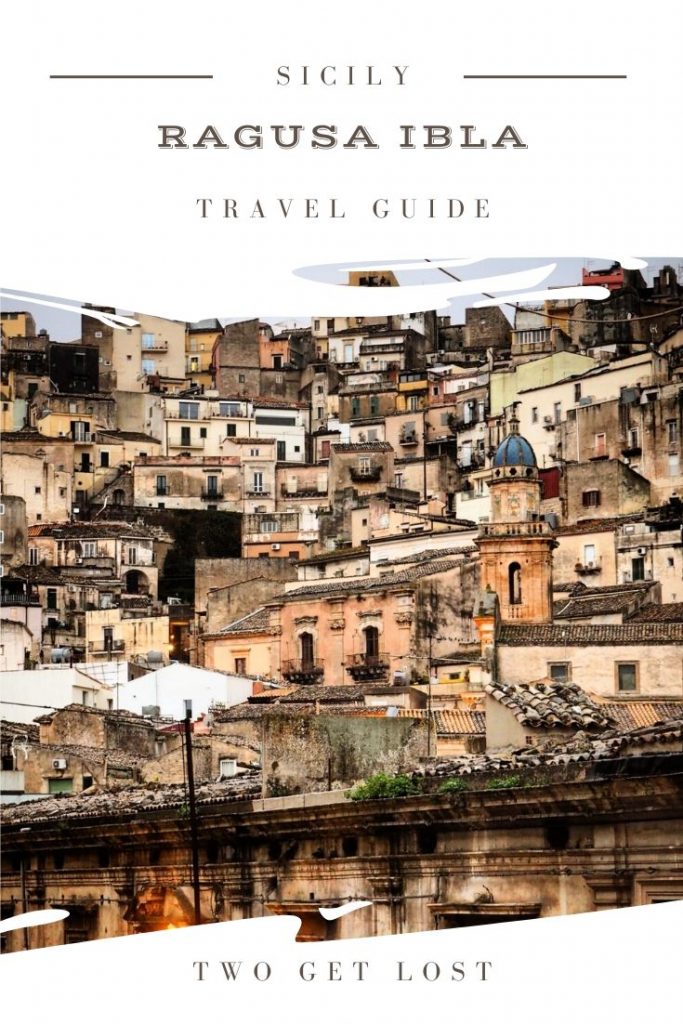
- Ragusa Ibla, just as beautiful as Ortigia!
- Valley of the Temples, a huge site of historical importance, and pretty incredible too!
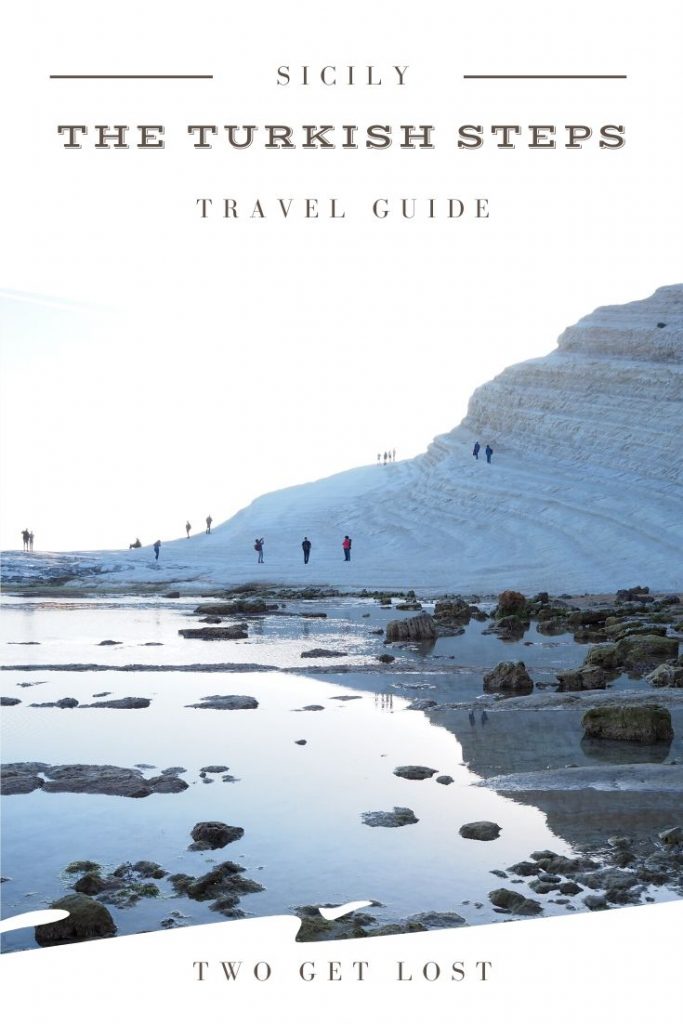
- The Turkish Steps, a stunning site of natural beauty



2 Comments