
Cats On A Boat: The Ultimate Guide
If you’re wondering whether it’s possible to keep your cats on a boat then you’re not alone. We’ve met many a sailor with at least one furry friend on board.
Before we got Tiny Cat, our Greek rescue kitten, we decided we would never have a cat onboard. We thought cats needed outside space to explore, and that they would hate life on a sailboat.
Tiny Cat pounced into our lives and although we did try and rehome her (thus the name Tiny Cat – we were never meant to keep her!) we couldn’t stand to give her up. She had become family. So we started searching for ways to keep cats happy on a boat. It turns out they absolutely can have great lives at sea.
But there are a few things to consider assigning yourself a new first mate. We take a look at keeping cats on a boat in this helpful guide, after having Tiny Cat on board with us for four years now.

Tiny Cat even has a book written about her. You can check out her story and buy a copy of Tiny Cat Adventures here!
Our Own Cat On A Boat

As an Amazon Associate, we earn from qualifying purchases. We also earn from other affiliate programs. This means we may receive a small commission on products purchased through our links at no extra cost to you.
We are big cat fans (who isn’t!?) but we weren’t at all sure about having cats on a boat. We thought they would miss having outside space to roam around in, that it would make travelling from country to country in our sailboat really hard and that they’d constantly be falling overboard and we’d be diving in after them!
When a two week old kitten showed up outside our boat at a Greek boat yard we did everything we could to encourage her to leave before we gave in and fed her. She was the size of the palm of my hand and looked as though she had never eaten. We decided to feed her up, make her strong and set her free. But the cat had different plans.

After many failed attempts to get her used to boatyard life and many long discussions about how impractical it would be to have a cat on a boat, our hearts won over and we threw caution to the wind, deciding to keep her.
We’d called her Tiny Cat, not wanting to give her a real name as we weren’t meant to be keeping her. And no matter how hard we tried to call her something else, Tiny Cat had just stuck. And so it was that Tiny Cat became our newest, cutest crew member and we became proud owners of a cat on a boat.
Cats On A Boat

Here are our experiences (positive and negative) about living with cats on a boat for anyone like us, who is doubtful about whether or not it can work. We’ve received so much useful advice from others, and even if we haven’t followed it for Tiny Cat we’ve shared it here in case it works for your cat.
We’ve also added the ultimate boat cat shopping list at the end so that you don’t have to trail around random foreign shops for hours trying to find the right equipment. Just order it all at once while you’re in a marina, at home, or near a post office and you can tick one of the main problems we had off your list!
Like people, cats all so different, so it might take a little trial and error at first to work out what suits your cat on a boat best! One thing we’re sure of though – you won’t regret it! Good luck – we can’t wait to hear how it all goes!
Jump To: Cats On A Boat
Keeping boat cats safe at anchor
Keeping boat cats safe underway
Taking your boat cat to the vet

Keeping Your Cats On A Boat Safe At Anchor
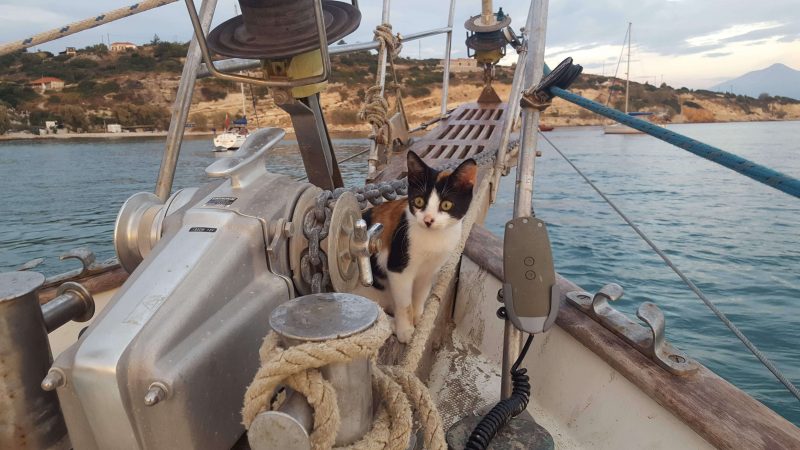
It seems that if a cat’s going to go for a swim, it will most likely happen at anchor. While the boat’s underway, Tiny Cat tends to be a little cautious and stays in the cockpit or down below.
At anchor, however, the boat is her playground and she becomes a bit of a demon! She hasbeen for a swim (accidentally) twice now, both times when she jumped into the tender to catch a fish that had jumped in there.
There are a few steps you can put in place to try and keep them safe while at anchor. Try and learn how your cat behaves on board before you decide on the right methods for you!
Teach Your Boat Cat To Swim

Most cats can swim naturally, they sort of paddle their legs and stay afloat! But not all cats like to swim.
We had grand ideas of getting Tiny Cat in the water at a young age and teaching her to swim, but one dip in the water showed us swimming was not for her. She now has a healthy fear of the water, and will peer in at a distance but is aware that the sea is not where she wants to be!
On the flip side, if you know your cat can swim then you can be more confident they’ll be able to get themselves to safety. We’ve met people whose cats regularly go for a dip and pull themselves out again.
Show Your Boat Cat How To Climb A Ladder
While at anchor, make sure you always trail something in the water for them to climb up. You can use a DIY rope ladder or something already designed for purpose. But make sure it’s weighted slightly at the bottom so it doesn’t fly away from them as they try to get a grip.
You should then test it to make sure they know it’s there and can use it. On a calm day take your cat for a swim and show them the ladder. You might want to ask a friend to take them in so they don’t hate you too much afterwards!
We did this when Tiny Cat was really small and when she did fall in the water she immediately climbed up out of the water using the ladder.
One of the times she fell in the ladder was actually in a different place (We’d temporarily moved it and it just happened to be the time she fell in!) She just swam around the boat till she found it and climbed back in. It was quite amazing to watch!
Keep an Eye On Your Sailboat Cat

We don’t let Tiny Cat onto the deck unless we’re around. That way, if she falls in then we’ll know about it and be able to help her out if she’s in trouble. If you get them a collar with a bell it’s much easier to keep track of them, but the ringing in the night drove us crazy so we abandoned that idea.
Keeping Your Boat Cat Safe When Sailing

When Tiny Cat was very small she didn’t leave our side, and certainly didn’t want to explore anything other than the safety of the cockpit. Now she’s older and more confident she loves to roam a little, and we’re starting to have to put strategies in place to keep her safe at sea.
Train Your Cats On A Boat To Wear A Harness
If you can, get your cat used to wearing a harness. While we’re sailing we can let Tiny Cat roam the cockpit on a lead so there’s no danger of an emergency COB situation!
Use A Basket To Keep Them Out Of The Way

We also keep her cat basket in a corner of the cockpit. It’s sheltered from the nip of the wind but still amongst all the action, so she often chooses this as a place to rest while we’re on passage.
If the weather starts getting at all rough, or we’re in any sort of ’emergency’ situation, we just throw her in the basket and zip it up to keep her safe and out of the way.
Lines Aren’t A Game!
The other thing you need to watch out for is cats in ropes! Tiny Cat thinks chasing the furling line is an awesome game, but we are terrified of her getting a claw stuck as it runs loose. If she’s getting too boisterous underway, into the basket she goes!
Opt For A Tiny Life Vest
It’s also possible to get life vests for cats (or small dogs), but we haven’t found one that fits Tiny Cat. If they’re tied in with a harness then hopefully they don’t need a life vest anyway!
Cats In A Marina Or Town Quay

Cats love to explore. But usually their house stays in one place. We didn’t think Tiny Cat would get off the boat without us, but once she’d worked out we were going to a neighbouring boat for drinks she somehow got out a top hatch and appeared in their cockpit!
We realised then that we would have to put a bit of work into training her if we wanted her to be safe while we were next to land.
Note: Always make sure cats are welcome at a marina before you book it. Some marinas don’t allow cats and it’s important to know beforehand so you don’t lose your deposit!
Teach Them To Come When Called
This one’s easy because cats love food. Train her to know that when you call her name and she comes, she gets something yummy. This didn’t take long to work for Tiny Cat, and it’s been a big help for finding her when she decides to play hide and seek on board as well!
Teach Cats To Only Leave The Boat With A Harness
We haven’t managed this, but a great piece of advice we got was to teach your boat cat to only leave the boat when they’re in their harness. That way you have complete control over their comings and goings!
Get Them A Collar
Because Tiny Cat is almost always on our boat we didn’t even think of getting her a collar. Then we saw a story about a sailor who found a kitty hiding in their boat, and he knew it must have an owner because of the collar, and we realised people would think Tiny Cat was a stray if they found her and wouldn’t think to search for an owner!
We bought her a fishy collar which she wears all the time now.
Talk To Your Neighbours
Adam and I are incredibly guilty of feeding random cats bits of our dinner – I think a lot of cat lovers are! But if your cat learns to go begging on other people’s boats then who knows which cubby hole they’ll choose to fall asleep in and where they’ll wake up!
If you’re staying somewhere with boat neighbors then it might be a good idea to ask that they discourage your cat from climbing aboard their boat. Not feeding them will take away any incentive. Some boat owners spray roaming cats to keep them away, but a loud shout will usually do the job!
Cat Food On A Boat

This is one of the biggest problems we’ve found with having Tiny Cat on board. She’s incredibly fussy and although we’ve tried so hard to get her eating anything she just refuses to.
Basically, food is a bit of a pain when having cats on a boat, but here are a few pieces of wisdom we’ve learnt along the way.
Stock Up
Cats can be incredibly fussy. We find it hard to find the food she likes best while sailing, as every supermarket sells a different brand. If your cat is as demanding as ours then stock up on their favourite food whenever you can so you always have some on board just in case.
Sensible Storage

Buy a large air-tight container like this to store any dry food. In the humidity of the boat, it goes off so quickly, and also tends to attract unwelcome visitors!
Clear Up Immediately After Cats On A Boat
Wet food is all Tiny Cat will eat, and she will not eat it all, no matter how small a portion we give her. So unless we stand over her and clear up immediately there is always a little wet food left out attracting flies and other bugs.
Use A Slip Proof Mat
Place your food and water bowls on a slip-proof mat while underway. That way, if the boat goes flying, their food hopefully won’t!
Cat Litter On A Boat

Alongside food, cat litter on a boat is a nightmare. I won’t sugarcoat it for you! Not only is it a heavy, bulky item to lug back to the boat and store but cat litter is also super absorbent and will soak up any moisture from anywhere.
As with dry cat food, you’ll want an air-tight container for your cat litter as it will attract bugs.
A litter tray is also not a small item to be lying on the floor of your already tiny sailboat. And I won’t mention the smell.
We have put a lot more time than we’d like to admit into researching the best litter trays and we’ve invested in a Breeze litter tray. It’s incredible, and worth every penny.
The Breeze system has a special grate in the bottom and a litter pad in a drawer under it. You use non-clumping litter so that the urine passes through and into the tray. Then you change the pads roughly once a week for one cat, and scoop the poop as with a normal litter tray.

The real benefits are…
- Breeze takes far less litter than a normal litter tray, so you can basically store a whole seasons worth of litter and not have to buy more as you go.
- Because the litter is solid it doesn’t absorb moisture in the same way.
- There is a lot less mess and a lot less smell! It’s also much lower maintenance than a normal litter tray.
The problems are….
- The actual Breeze brands of refills for the pads and litter aren’t the cheapest, but we have found a few hacks along the way which we’ve shared below!
- It can take cats a little time to get used to the different texture of the litter. People suggest mixing your old litter with the new for a bit until your cat gets used to it.
Instead of the Breeze pads you can use puppy pads, or even nappies (though we have to admit that the Breeze ones did hide the smell for a lot longer). Instead of the non-clumping litter you can use any non-clumping cat litter, or we even read that one lady uses dried beans! We’ll give it a go and let you know if it works!
Update: We’ve been using dried beans for years now and it works an absolute treat!
Boat Cat Claws

Unless you live in a marina, your boat cat probably isn’t getting outside as much as other cats. Without trees to climb and scratch their claws get very sharp, and unless you want tiny holes in all your clothes you’ll want to get a couple of things to help them out!
Firstly, get a scratch post for them. Something like this is perfect for cats on boats because it doesn’t take up any space at all and sticks to a range of surfaces.
Next get a pair of cat nail scissors and trim the sharp ends of their claws every now and again. This step really saved us when Tiny Cat decided that climbing us was her favourite new game to play!
Toys For Cats On A Boat
This sounds like a bit of a silly thing to consider, but if your cat is young then getting a few well chosen toys will make a big difference. When we first got Tiny Cat we were no where near a vet, so I tried making her a few toys. They weren’t very entertaining for her, so then we bought some little balls for her to chase. These were a big hit for her, but terrible for us. In such a small space it’s very hard to keep any cat toys under control!
We would recommend getting a couple of small toys that can be used in a tiny space and won’t get in the way if accidently left out. This laser pen is brilliant, and we also loved these toys on sticks as they’re easy to use in a tight companionway.
Getting Vet Care For Your Cat While Sailing

There are a surprising amount of vets in the world and it actually isn’t as hard as we expected to find them. They’re usually pretty cheap as well! That being said, on passages we do sometimes worry what we would do if something happened to Tiny Cat. We have some basics on board from the vet, but ultimately it is a little bit of a risk and one you might not want to take if your boat cat is older and more fragile.
Cats On A Boat And Seasickness

We didn’t realise that cat seasickness was a thing until we had a cat on a boat! We think Tiny Cat got quite sea sick the first few times we took her out for a sail – she went a little listless and took herself off on her own.
Cats are quite good at working out what they need so see where your cat decides to sit it out and let them get on with it. Try to make your first few sails with your liveaboard cat short ones in calm weather to get them used to the motion of the boat at sea.
Tiny Cat got used to it very quickly, but other cats don’t and for some, sea life just isn’t for them. We’ve heard you can ask your vet about medication for seasickness but we have no first hand experience of how effective this is!
Checking Your Cat Into New Countries

Cats are actually easier to check into new countries than dogs a lot of the time, because it’s much easier to quarantine cats on a boat. Every country has different laws about bringing pets into their country, so it’s important to check what these rules are before turning up.
From what people say, Australia and New Zealand are the hardest places to bring boat cats and the most expensive. There are high charges in other countries too, so make sure you check that out before sailing there.
You’ll need to make sure your boat cat has a pet passport before taking it to any new country. This can be quite expensive and take a little while so make sure you start the process asap.
Flying Your Cat Home

Again, how easy it is to fly your cat home with you depends on the country you’re flying into.
Flying within the EU is actually pretty easy. You can take your boat cat with you onto the plane and they then tuck under the seat as you fly. We have some cat calming tablets – I’m not sure if they make a difference or not but she loves them so that’s something! You can also get cat calming collars which we haven’t tried yet but get great reviews.
To get to the UK is a different process altogether! Your cat is only allowed to fly into Heathrow in the hold, and they will only accept a certain number of new animals a day. You have to book your flight, contact the airline provider and pay them around £700, they then contact Heathrow to find out if they have space for your cat that day. If they don’t you have to book a flight for another day and start the process all over again until you just happen to find a day that works.
It’s the craziest thing we’ve ever heard! I’ve done a lot of research into getting a cat into the UK and will share my findings in a different post for anyone that’s desperate!
Cats On A Boat Community
There are many, many people out there who are sailing with cats on their boat. It’s far more common that Adam and I realised. Because of this there is a wealth of advice about how best to care for a cat on a boat. The other great thing is that the boat cat community is pretty darn passionate about their cats, and everyone else’s, so they’re super helpful and will answer any questions you have quickly and in detail.
We’ve learnt the most from Facebook group communities – just search ‘cats on boats’ and you’ll find several large groups you can join.
FAQs About Keeping Cats On A Boat
How Many Cats Can You Keep on a Sailboat?
I guess this is kind of up to you and how big your sailboat is, but I would try and remember that they’ll all need to use the toilet! And I can tell you now that one cat using the litter tray on board is quite enough for Adam and I! We met a couple with four cats onboard their 40ft catamaran, and the cats were perfectly happy.
The more cats you have on your boat, the more moving creatures there are to keep an eye on, so our advice is always to start with one if you don’t have any yet. That way you can get used to what it’s like with a cat to look after on your sailboat and make an informed decision about whether or not to get another. If you’re planning on bringing your cats with your from home then just make sure the boat is set up well for the number of cats you’re bringing.
What Are The Benefits Having A Boat Cat?
The main and most obvious reason to have a cat on a sailboat is companionship. If you’re an animal lover it can be hard to move onto your new home and not have your ‘creature comfort!’ with you to make it feel like a real home. Cats are an extra crew member. They make you laugh, they give you a cuddle (if you’re lucky), and they’re entertaining. Plus it’s been proven that being around animals improves your mood!
If you want a more practical reason to keep a cat on a boat, then they’re great at pest control! Cats will make sure you don’t suffer the same fate we’ve seen many cruisers have to deal with – rats and mice on board. If you’re trying to persuade a hesitant partner then try this excuse!
Should I Choose An Indoor Or Outdoor Cat For My Sailboat?
If you’re bringing an indoor cat with your from home onto your sailboat then you’re probably wondering how you’ll keep it inside the boat. Honestly, this will completely depend on so many different factors.
If you anchor out year round then it won’t be a problem. Your cat will basically be an indoor cat, especially if your cat is used to having a balcony to laze around on.
The main issue will be keeping your cat onboard if you go into marinas and on town quays regularly. If you sail in a cold climate where you’ll want to keep the windows and hatches closed year round then this won’t be too much of a problem, but if you will be sailing in warm climates then you’ll need to think it through a bit more carefully. You’ll want to keep hatches and windows open to ventilate the boat. One solution is to use mosquito hatches and window covers, but Adam and I find they still significantly stifle the breeze.
For that reason we’ve chosen to let Tiny Cat roam when we’re in marinas. The negatives to this are the fact that she can pick up ticks and fleas, and that she probably isn’t as safe. We have to pick winter marinas a little more carefully – for example we make sure they aren’t near any main roads. We also make sure we leave a ladder in the water for her in case she falls in, but there’s always a risk she’ll fall when roaming and won’t be able to get out.
For us the risks are worth the reward of seeing her so happy with her freedom during the winter months. But it’s a decision you’ll have to make based on the needs of you and your cat.
How Do I ‘Cat-Proof’ My Sailboat?
Most boats are already pretty cat proof, but there a few things you’ll want to check. Make sure they can’t get into the bilges or engine compartment. You should also check there are no open wires anywhere that they can chew through. Careful with access to cupboards that contain any dangerous chemicals and make sure everything is stowed away properly when you’re underway so nothing falls on them. Cats love to explore sailboat cupboards, so make sure they’re not trapped inside before you leave the boat!
Cats On A Boat Shopping List
Aside from plentiful supplies of your cats favourite foods there are a few things that it’s worth investing in to make your boat cats life (and yours) a little easier! I’ve put it together in this handy shopping list so you can get it all at once while you’re close to a post office or tucked up in a marina.
Hopefully you’ve found some of this information about cats on boats useful, and you feel a little more confident about having your cat on board! We would love to hear your boat cat stories in the comments section below so let us know how they’re finding life aboard!






Thank you for sharing your experience with a boat cat!! Very helpful. We will be living aboard our 45foot Carver starting this Spring 2023. Charley our 2.5 year old cat will live with us. Charley has never used a litter box. He is a inside/outside kinda of cat. He lets us know when he needs to go out, plus he loves to hunt! People tell me “oh, he will use the box” well he has been inside for 8/9 hours and we have the box out, but nope. So this issue will be a challenge. Any suggestions?