
Is Nepal In India? The Location Of Nepal
If you’re wondering whether Nepal is in India then you’re not alone. Before we visited the two distinct countries we assumed they would be pretty similar, as Nepal shares so much of its border with India. But what we found surprised us!
When it comes to the diverse and captivating landscapes of South Asia, few countries capture the imagination quite like Nepal and India. Nestled amidst the majestic Himalayan mountains, these nations boast a rich cultural heritage, awe-inspiring natural wonders, and a tapestry of historical connections.
They are some of the most interesting countries we’ve ever visited, and while they do have their similarities it is very clear when you visit that Nepal is not in India.
In this blog post, we embark on a journey of exploration to unravel the geographical relationship between Nepal and India, shedding light on their shared history, distinct identities, and the factors that make each nation unique.
Join us as we delve into the geographic tapestry of these remarkable countries, dispelling any misconceptions along the way.
As an Amazon Associate, we earn from qualifying purchases. We also earn from other affiliate programs. This means we may receive a small commission on products purchased through our links at no extra cost to you.
Table of Contents
- Is Nepal In India?
- Was Nepal Part Of India In The Past?
- How Is Nepal Different From India?
- Where Is Nepal Located?
- Where Is India Located?
- FAQ
Is Nepal In India?
✔ Don’t forget your travel insurance! We use Safety Wing and highly recommend it. With insurance designed for frequent travelers and digital nomads, it ticks all the right boxes. ✔
No, Nepal is not in India.
Nepal is a separate country located in South Asia, situated mainly in the Himalayas between China (Tibet Autonomous Region) to the north and India to the south, east, and west. It shares borders with India on its eastern, southern, and western sides.
Before we visited Nepal it was easy to assume it would be very similar to India, as the two countries are so close in proximity. But in fact, they are very different and even just crossing the border it becomes obvious these two distinct countries are separate.
Nepal is an independent nation with its own government, culture, and history. Although people often confuse it with being a part of India it is its own country and has a very different feel to India.
Was Nepal Ever Part Of India?
Nepal has never been a part of modern-day India. However, historically, Nepal and India have had close cultural, economic, and social ties due to their geographical proximity and shared heritage.
Nepal was ruled by various dynasties throughout history, including the Licchavi, Malla, and Shah dynasties.
During the 18th and 19th centuries, the British East India Company expanded its influence in the Indian subcontinent, including parts of present-day India, Nepal, and other regions.
The British and the Kingdom of Nepal signed the Sugauli Treaty in 1816, which established the present-day borders between Nepal and India. This treaty recognized Nepal’s sovereignty as an independent state.
While Nepal and India share open borders, have cultural exchanges, and have citizens who frequently travel between the two countries, Nepal remains a separate and sovereign nation.
Where Is Nepal Located?
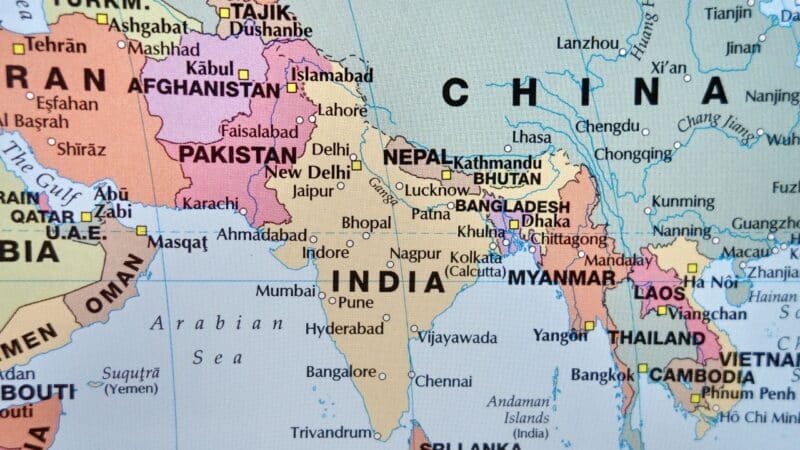
Nepal is located in South Asia, specifically in the Himalayas. It is situated between China (Tibet Autonomous Region) to the north and India to the south, east, and west.
With India bordering Nepal on so many sides, it’s easy to see why some people mistake Nepal for being in India, but honestly, you just have to visit the two to see how different they are.
Nepal has a diverse geography, ranging from lowland plains in the south to the highest peaks in the world, including Mount Everest, in the north.
Many people backpack Nepal every year for a glimpse of the Himalayas, and in particular Mount Everest, but there is a lot more to this beautiful country. Some of the highlights for us included spotted tigers in Chitwan National Park and exploring the best things to do in Pokhara.
Where Is India Located?
India is located in South Asia too, sharing borders with several countries. It is situated to the north of the Indian Ocean.
India shares its borders with Pakistan to the northwest, China and Nepal to the north, Bhutan to the northeast, and Bangladesh and Myanmar (Burma) to the east.
To the south, India is surrounded by the Indian Ocean, with the Arabian Sea to the west and the Bay of Bengal to the east.
The country spans a vast land area, covering approximately 3.29 million square kilometers (1.27 million square miles). It’s possible to find many different cultures and vibes all within the same country, so if you visit India you might want to travel a little to absorb some of the differences.
How Is Nepal Different From India?
Nepal and India are distinct countries with their own unique characteristics. Here are some key differences we found between Nepal and India:
- Geography: Nepal is known for its mountainous terrain, including the majestic Himalayas, with Mount Everest being the highest peak in the world. India, on the other hand, has a diverse geography, encompassing mountains, plains, plateaus, and coastal regions.
- Size: India is much larger in terms of both land area and population. It is the seventh-largest country in the world by land area, whereas Nepal is relatively smaller.
- Political System: Nepal is a federal democratic republic with a multi-party system. India, on the other hand, is a federal parliamentary democratic republic with a president as the head of state.
- Religion: Nepal is predominantly Hindu, with Hinduism being the major religion. However, Nepal also has a significant Buddhist population, and there are other religious and ethnic minorities as well. India, on the other hand, is a multi-religious country with a diverse religious landscape, including Hinduism, Islam, Christianity, Sikhism, Buddhism, and others.
- Language: Nepal’s official language is Nepali, while there are several regional languages spoken across the country. India is a linguistically diverse nation with hundreds of languages spoken, including Hindi, Bengali, Tamil, Telugu, Marathi, and many more.
- History and Culture: Nepal has its own distinct history and cultural heritage, influenced by a blend of Hindu and Buddhist traditions. India, being a vast and diverse country, has a rich and varied history, with numerous ancient civilizations and cultural traditions.
- International Borders: Nepal shares borders with India and China, while India shares borders with several countries, including Pakistan, China, Nepal, Bhutan, Bangladesh, and Myanmar. You can see different influences when you travel in India.
Despite these differences, Nepal and India have historical, cultural, and economic ties and share a border that promotes people-to-people exchanges and trade between the two nations.
Frequently Asked Questions: Is Nepal In India
We’ve answered some of your most asked questions about Nepal and India below to help you get a better understanding of the two different countries.
Is Nepal A Country?
Yes, Nepal is an independent and sovereign country. It is officially known as the Federal Democratic Republic of Nepal. Nepal has its own government, constitution, flag, and international recognition as a separate nation.
It gained its independence and established itself as a modern nation-state in the mid-18th century. Nepal is a member of the United Nations and maintains diplomatic relations with numerous countries around the world.
What Country Does Nepal Belong To?
Nepal is an independent country and does not belong to any other country. It is a sovereign nation with its own government, territory, and international recognition. Nepal has its own distinct identity and is not a part of any other country.
Remember, Nepal is not in India!
Why Is Nepal Not Part Of India?
Nepal is not part of India due to historical, political, and geographical reasons. Here are a few key factors:
- Historical Background: Nepal has a long history as a separate kingdom with its own ruling dynasties. It maintained its independence and distinct identity even during the period of British colonization in the Indian subcontinent.
- Treaty of Sugauli: In 1816, the Sugauli Treaty was signed between the British East India Company and the Kingdom of Nepal. This treaty defined the borders between Nepal and British India, recognizing Nepal’s sovereignty as an independent state.
- Geographical Separation: Nepal is geographically separated from India by the Himalayan mountain range. The rugged terrain and difficult mountain passes made it challenging for any attempts at territorial expansion.
- Cultural and Ethnic Identity: Nepal has its own unique cultural, ethnic, and linguistic diversity, distinct from India. It has a majority Hindu population but also has a significant Buddhist community and other ethnic and religious groups. The people of Nepal have their own traditions, customs, and social structures.
- International Recognition: Nepal is internationally recognized as a separate and sovereign country. It is a member of the United Nations and maintains diplomatic relations with other nations as an independent entity.
While Nepal and India share open borders and have historical, cultural, and economic ties, Nepal remains a separate nation with its own government, constitution, and independent status.
Is Nepal And India The Same?
No, Nepal and India are not the same. They are two separate countries with distinct identities, governments, and territories.
Nepal is an independent country located in the Himalayas, situated between China to the north and India to the south, east, and west. India, on the other hand, is a much larger country in South Asia, bordered by several countries including Nepal.
Although Nepal and India have historical and cultural connections due to their geographical proximity, they have their own unique histories, languages, cultures, and political systems. Nepal and India have separate governments, with Nepal being a federal democratic republic and India being a federal parliamentary democratic republic.
Asides from these facts, Nepal and India just feel different to travel through. The food is different, the language is different, the culture is different. They are just very obviously different countries! I have to admit that as a female traveller I felt safer in Nepal than in India, but I’m sure this is based a lot on individual experiences.
While there are similarities and interactions between the two countries, as we keep saying it is important to recognize that Nepal and India are distinct nations with their own sovereign status and separate identities.
Is Nepal Related To India?
Yes, Nepal and India share a close and intertwined history, culture, and geographical proximity. However, it is important to note that while the two countries have a historical connection, Nepal is an independent and sovereign nation separate from India.
Nepal and India have a long-standing relationship that dates back centuries. Historically, Nepal has been influenced by Indian civilization, culture, and religion. Hinduism, Buddhism, and various cultural practices have permeated both countries, leading to shared traditions and customs. Nepal was also ruled by various Indian dynasties and kingdoms throughout history.
Geographically, Nepal is landlocked and located in the Himalayas, bordered by India on three sides: the east, west, and south. The open border between Nepal and India facilitates trade, tourism, and cultural exchanges, contributing to a close relationship between the people of both countries. There are also significant population movements, with Nepali people living and working in different parts of India, and vice versa.
Furthermore, both nations have diplomatic relations and engage in various bilateral agreements on trade, transit, and cooperation in various sectors. India has been an important economic partner for Nepal, and both countries have collaborated on infrastructure development, energy projects, and cultural exchanges.
However, it is crucial to emphasize that Nepal is an independent country with its own government, laws, and international relations. Nepal has its own unique history, language (Nepali), culture, and political system. It is recognized as a sovereign nation by the international community and maintains its distinct identity.
Can I travel To Nepal Without A Passport From India?
No, you cannot travel to Nepal from India without a passport. A valid passport is required for international travel, including travel between India and Nepal. Both countries have separate immigration systems, and crossing the border requires presenting a passport for identification purposes.
You should make sure you check up to date information on travel requirements to or from Nepal or India in advance, as you might also need visas and other documents.
Conclusion: Is Nepal In India?
In conclusion, Nepal is not in India.
Despite their geographical proximity, historical connections, and cultural influences, Nepal and India are separate and sovereign nations.
Nepal is an independent country with its own government, laws, language, and unique cultural heritage. While Nepal shares borders with India and has had a long history of interactions and influences from Indian civilization, it is crucial to recognize and respect Nepal’s distinct identity and sovereignty.
Both countries maintain diplomatic relations and engage in various forms of cooperation, but they are separate entities with their own governance and international recognition.
It is important to appreciate and celebrate the rich diversity and individuality of both Nepal and India, recognizing them as distinct nations with their own unique contributions to the world.


